Artist Room
About the Artist Room
This guest room treats the space itself as a canvas or atelier, transforming the entire room into an artwork by applying art directly to the walls. For this project, calligrapher MAMIMOZI expressed her stay experience at Warakuen through brushwork, creating an artistic piece.
Furthermore, all built-in and freestanding furniture was crafted by Legnatec Co., Ltd., based in Saga Prefecture. It harmonizes with furniture designed by a world-renowned designer who visited Saga Prefecture and expressed their impressions in their work.
The Concept of Artist Rooms
Since ancient times, inns have fostered an intangible culture where “literary figures and artists secluded themselves to immerse in creative pursuits.” We reinterpret this intangible culture as art, transforming guest rooms into “Artist Rooms.” These spaces become venues where artists directly create works within the rooms, drawing from their unique experiences and impressions gained in Saga Prefecture and Ureshino Onsen.
Room
龍宮RYUGU
Room size:90m2
This Artist Room treats the guest room itself as a canvas, creating the entire space as a work of art by applying art directly to the walls. With the Ariake Sea as its subtheme, the navy-blue-toned space evokes the ebb and flow of the tide as time passes. Calligrapher MAMIMOZI expresses the world she felt during her stay at Warakuen through her “sho” (calligraphy), carving a story and deep resonance into the space. All furniture is crafted by Saga Prefecture-based manufacturer Legnatec. This special guest room resonates with local culture and creativity, blending the sensibility of a world-class designer with artisan craftsmanship.
About the “Ryugu” Description
“I leave the choice of characters to you,”
the third-generation owner requested. While being healed by the waters of Ureshino, renowned as one of Japan's Three Great Hot Springs for Beautiful Skin, I racked my brain for inspiration.
Left Wall: “Ryūgū”
Wall: Matte indigo blue
Ink: Glossy navy blue
*Space left below for the bed to be installed
Right Wall: “Turtle Tale”
Wall: Matte indigo blue
Ink: Glossy black, glossy navy, matte teal
The “Turtle Tale” written in three colors changes appearance depending on the angle, allowing me to complete a flat work that feels almost three-dimensional.
Reasons for choosing the characters for “Ryugu”
① Inspired by the “Turtle Tale” story, where the turtles in the pond at Warakuen's entrance longed for Princess Otohime of Ryugu Palace.
② Ryugu Palace is home to the Water Deity. Warakuen cherishes tea and hot springs, both of which revolve around water.
③ Those who journey to Ryugu Palace are granted treasures. I myself spent many precious, treasured moments at Warakuen.
④ Within walking distance of Warakuen is a shrine dedicated to Toyotama-hime (also known as Princess Otohime). I visited it before writing.
~Since the third-generation owner said it was okay to include personal anecdotes~
⑤ During my two days at Warakuen, a refreshing rain fell, and it felt as if the Dragon God was pleased.
⑥ here is new life within me, and water (amniotic fluid) is incredibly important. Given that I conceived and will give birth in the Year of the Dragon, and that Warakuen is also embarking on new challenges this year for its 50th anniversary, I chose to write “竜宮” as “龍宮”.
Excerpt from calligrapher MAMIMOZI’s Instagram post
Calligrapher MAMIMOZI

Calligrapher / MAMIMOZI
MAMI picked up the brush at the early age of nine.
By high school, her intimate struggle for self expression could be seen in her strokes.
Fusing the visual language of graffiti, a product of Hip Hop culture, and traditional calligraphy,
MAMI has established her own sense of style - ʻCalligraf2ity.ʼ
Through her solo exhibitions and performances, her unique expression has circled the globe,
starting from Japan and to over 40 countries.
Currently, she is based in Japan, in Tokyo / Shibuya and she often travels the world to share her distinctive style.
- Calligraf2ity - A modern twist on a traditional Japanese art form; “Calligraf2ity” combines
the hip hop culture of graffiti with another form of linguistic art: Japanese calligraphy.
Calligraphy + Graffiti = Calligraf2ity
What does this mean?
“2" represents the sound “fu” which is the traditional Japanese counting system: Hi fu mi yo... (for 1, 2, 3, 4…). Merging Japanese calligraphy with graffiti,
these “two” seemingly disparate cultures make up the fu(2)ture culture of Calligraf2ity.
About ARIAKE collection
ARIAKE is a furniture brand founded by Legnatec and Hirata Chair, two factories from the furniture producing town of Morodomi in Saga prefecture, Japan.
Named after the Ariake Sea in Southern Japan, ARIAKE means daybreak in Japanese. It symbolizes a new chapter for the two factories as they embark on a collaboration with international designers for the global market.
It is our belief that strong working relationships are the foundation of good products. Furniture is made for social situations where people live, work and eat together. The creation of the ARIAKE brand and furniture designs were done over two intensive workshops in Morodomi where furniture designers, art director, photographer and craftsmen did the same – we lived, worked and ate together over.
Despite language barriers, the designers and craftsmen generated a collective energy and mutual trust that helped define the soul of the brand. This resulted in a collection of furniture that utilizes the best of hand and machine, inspired by the spirituality of Japanese culture and urban living contexts.
We present to you a 30-piece collection made from oak, ash, hinoki, cedar, leather, paper cord, cotton canvas, upholstery and unique finishes such as sumi and indigo dye. Each piece is crafted in Morodomi, with furniture designs by Anderssen & Voll, Gabriel Tan, Keiji Ashizawa, Norm Architects, Note Design Studio, Shin Azumi, Staffan Holm, Zoe Mowat, Studio MK27, Photography Sebastian Stadler, Art Direction by AnnerPerrin.
Other guest room
-
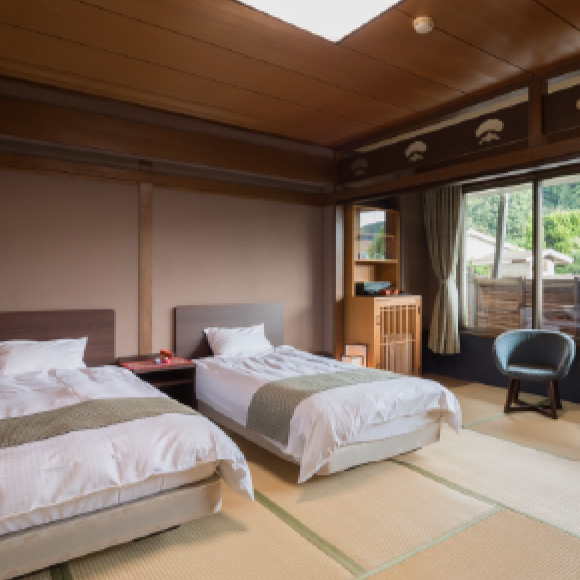 Main building
Good views on Ureshino river and the main street. A place for enjoying the Japanese-style Peacefulness.
-
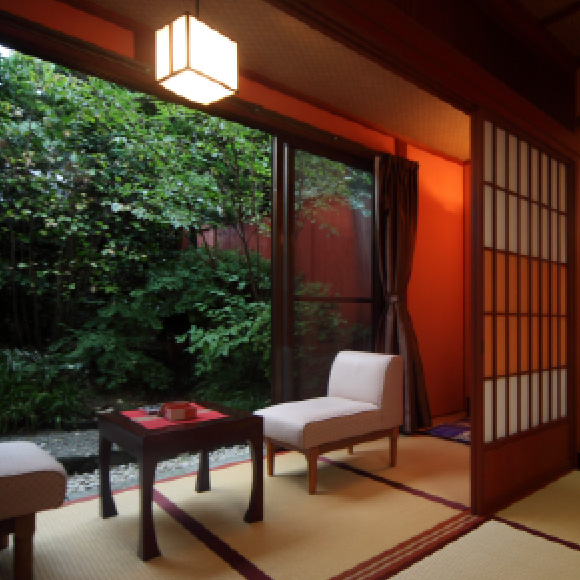 Guest room with outdoor bath Sazantei
A total of 7 rooms separated from the main building. All contains luxury special outdoor hot spring bath. We also have universal design rooms.
-
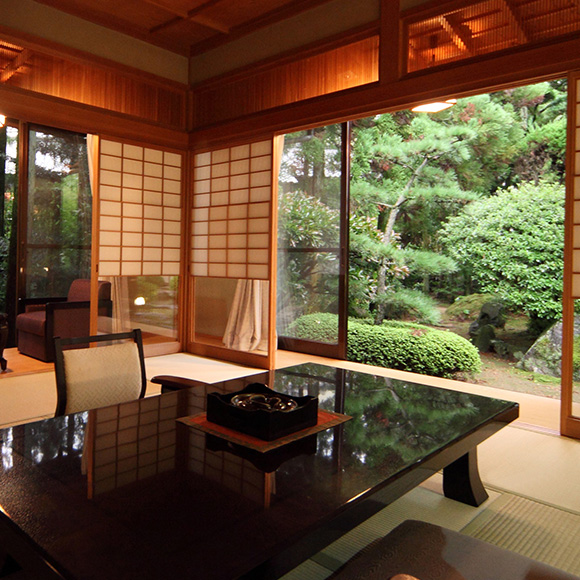 Tea ceremony designed guest room Suigetsu
Unique Japanese-style peacefulness atmosphere can let you trace the origin of the heart of the tea. An outdoor hot spring bath that specified for guests of Suigetsu is also offered.
-
 Tsuki Suite
There are a total of five guestrooms, all of which are decorated with elements that are “unique to Ureshino. Two of the five rooms are equipped with Aritayaki porcelain open-air baths.
-
 Artist Room
Artist Room dyed in navy blue.The shifting light within the guest room expresses the ebb and flow of the Ariake Sea.This is a guest room where calligrapher MAMIMOZI’s writing carves a story and deep resonance into the space.